



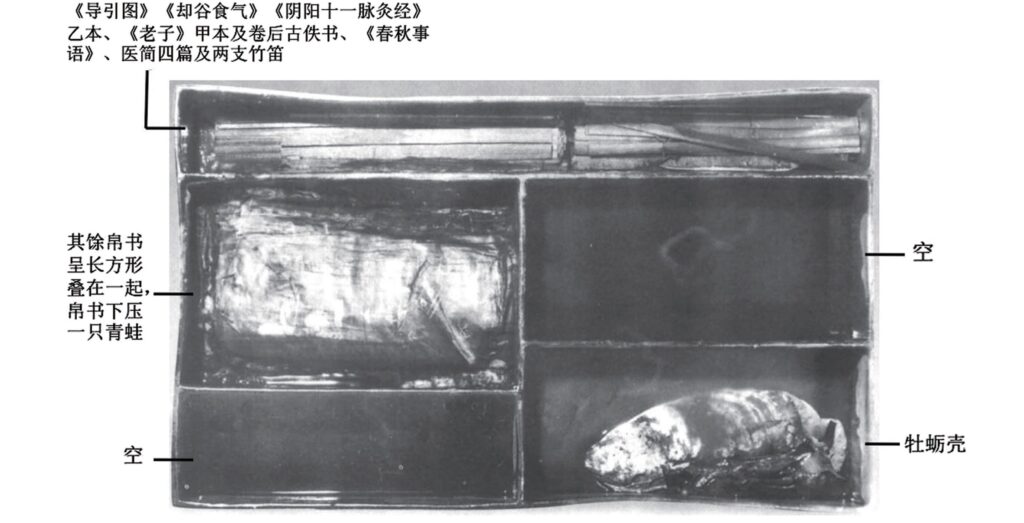
竹簡 《醫書》在漆奩(東57)內放置情況,長沙馬王堆三號漢墓
[湖南省博物館、湖南省文物考古研究所編著:《長沙馬王堆二、三號漢墓第一卷:田野考古發掘報告》(北京:文物出版社 ,2004年),圖版五二。]
- Barbieri-Low, Anthony J. “Craftsman’s Literacy: Uses of Writing by Male and Female Artisans in Qin and Han China.” In Writing and Literacy in Early China: Studies from the Columbia Early China Seminar , eds. Li Feng [李峰] and David Prager Branner, 370-399. Seattle: University of Washington Press, 2011.
- Behr, Wolfgang and Führer, Bernhard. “Einführende Notizen zum Lesen in China mit besonderer Berücksichtigung der Frühzeit.” [“Introductory Notes on Reading in China with Particular Consideration of the Early Period.”] In Aspekte des Lesens in China in Vergangenheit und Gegenwart [ Aspects of Reading in China, Past and Present ], ed. Bernhard Führer, 1-42. Bochum: Projekt Verlag, 2005.
- Boltz, William G. “Manuscripts with Transmitted Counterparts.” In New Sources of Early Chinese History: An Introduction to the Reading of Inscriptions and Manuscripts , ed. Edward L. Shaughnessy, 253-283. Berkeley: The Society for the Study of Early China and the Institute of Asian Studies, University of California, Berkeley, 1997.
- Boltz, William G. “The Composite Nature of Early Chinese Texts.” In Text and Ritual in Early China , ed. Martin Kern, 50-78. Seattle: University of Washington Press, 2005.
- Boltz, William G. “Literacy and the Emergence of Writing in China.” In Writing and Literacy in Early China: Studies from the Columbia Early China Seminar , eds. Li Feng and David Prager Branner, 51-84. Seattle: University of Washington Press, 2011.
- Branner, David Prager. “Phonology in the Chinese Script and Its Relationship to Early Chinese Literacy.” In Writing and Literacy in Early China: Studies from the Columbia Early China Seminar , eds. Li Feng and David Prager Branner, 85-137. Seattle: University of Washington Press, 2011.
- Dai, Lianbin [戴聯斌]. “China’s Bibliographic Tradition and the History of the Book.” Book History 17 (2014): 1-50.
- Du, Heng [杜恆]. “The Author’s Two Bodies: The Death of Qu Yuan and the Birth of Chuci zhangju 楚辭章句.” T’oung Pao 105.3-4 (2019): 259-314.
-
Du, Heng.
“The Mastery of Miscellanea: Information Management and Knowledge Acquisition in the ‘Chu Shuo’ Chapters of the
Hanfeizi
.”
Journal of the American Oriental Society
140.1 (2020): 115-141.
[For comparison] Even-Ezra, Ayelet. Lines of Thought: Branching Diagrams and the Medieval Mind . Chicago: University of Chicago Press, 2021. (Forthcoming)
[For comparison] Blair, Ann. Too Much to Know: Managing Scholarly Information before the Modern Age . New Haven & London: Yale University Press, 2011. - Durrant, Stephen. “From ‘Scribe’ to ‘History’: The Keyword shi 史.” In Keywords in Chinese Culture , eds. Wai-yee Li and Yuri Pines, 85-119. Hong Kong: The Chinese University of Hong Kong Press, 2020.
- Fischer, Paul. “Authentication Studies (辨偽學) Methodology and the Polymorphous Text Paradigm.” [〈辨偽學方法論與多形文獻範式〉] Early China 32 (2008-2009): 1-43.
- Fölster, Max Jakob. “Libraries and Archives in the Former Han Dynasty (206 BCE-9 CE): Arguing for a Distinction.” In Manuscripts and Archives , eds. Alessandro Bausi et al., 201-230. Berlin & Boston: De Gruyter, 2018.
-
Goldin, Paul R. “Xunzi in the Light of the Guodian Manuscripts.”
Early China
25 (2000): 113-146.
[Revised edition] Goldin, Paul R. “Xunzi in the Light of the Guodian Manuscripts.” In After Confucius: Studies in Early Chinese Philosophy , 36-57. Honolulu: University of Hawai’i Press, 2005.
[中譯本] 金鵬程撰,陳家寧 [Chen Jianing] 譯:〈郭店楚簡視角下的荀子〉,載金鵬程撰,陳家寧譯:《孔子之後:中國古代哲學研究》,頁49-74。鄭州:大象出版社,2019年。 - Goldin, Paul R. “ Heng Xian and the Problem of Studying Looted Artifacts.” Dao 12 (2013): 153-160.
- Gu, Mingdong [顧明棟]. Chinese Theories of Reading and Writing: A Route to Hermeneutics and Open Poetics . Albany: State University of New York Press, 2005.
- He, Ruyue [何如月] and Nylan, Michael. “On a Han-era Postface ( Xu 序) to the Documents .” Harvard Journal of Asiatic Studies 75.2 (2015): 377-426.
-
Ho, Che-wah [何志華].
“Use of Alternative Characters in the Annotations of Ancient Texts.”
[〈漢晉注釋依據異文訓解典籍研究〉]
Journal of Chinese Linguistics
[《中國語言學報》] 47.1 (2019): 1-41.
[See also] 林麗玲 [Lam Lai-ling]:〈古代典籍傳注與異文淵源考辨〉[“The Relation of Textual Variances to the Commentaries of Ancient Texts”],香港中文大學中國語言及文學系博士學位論文,2014年。
[See also] 何志華、林麗玲:《古籍傳注異文訓詁集證》,香港:香港中文大學中國文化研究所劉殿爵中國古籍研究中心,2015年。
[See also] 何志華:〈論漢晉傳注訓詁與古籍異文之關係〉,載何志華:《經義叢考》,頁89-113。香港:香港中文大學中國文化研究所劉殿爵中國古籍研究中心,2015年。 -
Hunter, Michael. “The ‘Yiwen Zhi 藝文志 (Treatise on Arts and Letters) Bibliography in Its Own Context.”
Journal of the American Oriental Society
138.4 (2018): 763-780.
[For comparison] Ryholt, Kim and Barjamovic, Gojko eds. Libraries before Alexandria: Ancient Near Eastern Traditions . New York, NY: Oxford University Press, 2019. - Kern, Martin. “ Shi jing Songs as Performance Texts: A Case Study of ‘ Chu ci ‘ (Thorny Caltrop).” Early China 25 (2000): 49-111.
-
Kern, Martin.
The Stele Inscriptions of Ch’in Shih-huang: Text and Ritual in Early Chinese Imperial Representation
. New Haven, CT: American Oriental Society, 2000.
[中譯本] 柯馬丁撰,劉倩 [Liu Qian] 譯:《秦始皇石刻:早期中國的文本與儀式》,上海:上海古籍出版社,2015年。 - Kern, Martin. “Ritual, Text, and the Formation of the Canon: Historical Transitions of Wen in Early China.” T’oung Pao 87.1-3 (2001): 43-91.
-
Kern, Martin.
“Methodological Reflections on the Analysis of Textual Variants and the Modes of Manuscript Production in Early China.”
Journal of East Asian Archaeology
4.1-4 (2002): 143-181.
[中譯本] 柯馬丁撰,李芳 [Li Fang]、楊治宜 [Yang Zhiyi] 譯: 〈方法論反思:早期中國文本異文之分析和寫本文獻之產生模式〉 ,載陳致 [Chen Zhi] 主編:《當代西方漢學研究集萃:上古史卷》,頁349-385。上海:上海古籍出版社,2016年。 -
Kern, Martin.
“Bronze inscriptions, the
Shangshu
, and the
Shijing
: The Evolution of the Ancestral Sacrifice during the Western Zhou.”
In
Early Chinese Religion, Part One: Shang through Han (1250 BC to 220 AD)
, eds. John Lagerwey and Marc Kalinowski, 143-200. Leiden: Brill, 2009.
[中譯本] 柯馬丁撰,陳彥輝 [Chen Yanhui]、趙雨柔 [Zhao Yurou] 譯:〈從青銅銘文、詩經和尚書看西周祖先祭祀的演變〉,《國際漢學》[ International Sinology ] 第1期(2019年),頁25-52。 -
Kern, Martin.
“Kongzi as Author in the Han.”
In
The Analects Revisited: New Perspectives on the Dating of a Classic
, eds. Michael Hunter and Martin Kern, 268-307. Leiden: Brill, 2018.
[中譯本] 柯馬丁撰,劉倩譯: 〈孔子:漢代作者〉 ,載王能憲 [Wang Nengxian] 等編:《從游集:恭祝袁行霈教授八秩華誕文集》,頁104-133。北京:中華書局,2016年。 -
Kern, Martin. “Xi Shuai 蟋蟀 (Cricket) and its Consequences: Issues in Early Chinese Poetry and Textual Studies.”
Early China
42 (2019): 39-74.
[中譯本] 柯馬丁撰,顧一心 [Gu Yixin]、姚竹銘 [Yao Zhuming] 譯,郭西安 [Guo Xi’an] 校: 〈早期中國詩歌與文本研究諸問題——從蟋蟀談起〉 ,《文學評論》[ Literary Review ] 第4期(2019年),頁133-151。 - Krijgsman, Rens. “The Rise of a Manuscript Culture and the Textualization of Discourse in Early China.” PhD. Dissertation, University of Oxford, 2017.
- Krijgsman, Rens. “An Inquiry into the Formation of Readership in Early China: Using and Producing the Yong yue 用曰 and Yinshu 引書 Manuscripts.” T’oung Pao 104.1-2 (2018): 2-65. [See also 武致知(Rens Krijgsman),《论早期中国阅读模式的形成:〈用曰〉〈引书〉的使用和制作》,《简帛》第22辑,上海古籍出版社,2021年,页85-130。
- Krijgsman, Rens. “A Self-Reflexive Praxis: Changing Attitudes Towards Manuscript and Text in Early China.” Early China 42 (2019): 75–110.
-
Lau, D. C. [劉殿爵] “A Study of Some Textual Problems in the
Lü-shih ch’un-ch’iu
and their Bearing on its Composition.”
Bulletin of the Institute of Chinese Literature and Philosophy
1 [《中國文哲研究集刊》創刊號] (1991): 45-87.
[中譯本]:劉殿爵撰,何志華 [Ho Che-wah] 譯:〈呂氏春秋文本問題探究——並論其對全書編排的意義〉,載《採掇英華》編輯委員會編:《採掇英華——劉殿爵教授論著中譯集》,頁259-287。香港:中文大學出版社,2004年。
[See also] 何志華: 〈王利器「呂氏春秋之編次本為六論、十二紀、八覽」說書證獻疑:兼論高誘注釋體例問題〉 [“A Rebuttal of Wang Liqi’s Hypothesis that the Composition of the Lüshi Chunqiu Should Be in the Order of the Six Lun , Twelve Ji , and Eight Lan “],《中國文化研究所學報》[ Journal of Chinese Studies ] 第48期(2008年),頁425-450 ; 林清源 [Lin Chin-yen]:《簡牘帛書標題格式研究》,臺北:藝文印書館,2004年。
[For comparison] Starr, Raymond J. “Cross-References in Roman Prose.” The American Journal of Philology 102.4 (1981): 431-437. - Lee, Hur-Li [李鶴立]. Intellectual Activism in Knowledge Organization: A Hermeneutic Study of the Seven Epitomes . Taipei: National Taiwan University Press, 2016.
- Lewis, Mark Edward. Writing and Authority in Early China . Albany: State University of New York Press, 1999.
- Li, Feng and Branner, David Pragner. “Writing as a Phenomenon of Literacy.” In Writing and Literacy in Early China: Studies from the Columbia Early China Seminar , eds. Li Feng and David Prager Branner, 3-15. Seattle: University of Washington Press, 2011.
- Li, Feng. “Literacy and the Social Contexts of Writing in the Western Zhou.” In Writing and Literacy in Early China: Studies from the Columbia Early China Seminar , eds. Li Feng and David Prager Branner, 271-301. Seattle: University of Washington Press, 2011.
-
Li, Wai-yee [李惠儀].
The Readability of the Past in Early Chinese Historiography
. Cambridge, MA: Harvard University Asia Center, 2008.
[中譯本] 李惠儀撰,文韜 [Wen Tao]、許明德 [Ming Tak Ted Hui] 譯:《左傳的書寫與解讀》,南京:江蘇人民出版社,2016年。 - Luca, Dinu. “Self-inscriptions: On Textual Figuration in Sima Qian and Ban Gu.” Bulletin of the Museum of Far Eastern Antiquities 79-80 (2018): 123-195.
- Meyer, Dirk. Philosophy on Bamboo: Text and the Production of Meaning in Early China . Leiden: Brill, 2012.
- Meyer, Dirk. “Bamboo and the Production of Philosophy: A Hypothesis about a Shift in Writing and Thought in Early China.” In Material Culture in Asian Religions: Text, Image, Object , eds. Benjamin J. Fleming and Richard D. Mann, 21-38. New York, NY: Routledge, 2014.
- Meyer, Dirk. “Truth Claim with no Claim to Truth: Text and Performance of the ‘Qiushui’ Chapter of the Zhuangzi .” In Literary Forms of Argument in Early China , eds. Joachim Gentz and Dirk Meyer, 297-340. Leiden: Brill, 2015.
- Nylan, Michael. “Toward an Archeology of Writing: Text, Ritual, and the Culture of Public Display in the Classical Period (475 B.C.E-220 C.E.).” In Text and Ritual in Early China , ed. Martin Kern, 3-49 Seattle: University of Washington Press, 2005.
-
Nylan, Michael.
Yang Xiong and the Pleasures of Reading and Classical Learning in China
. New Haven, CT: American Oriental Society, 2011.
[For comparison] Lynch, Deidre Shauna. Loving Literature: A Cultural History . Chicago: University of Chicago Press, 2015.
[For comparison] Howley, Joseph A. Aulus Gellius and Roman Reading Culture: Text, Presence and Imperial Knowledge in the Noctes Atticae . New York, NY: Cambridge University Press, 2018. - 龔韻蘅, 話語招魂術裏的雙重性格-揚雄之書寫模式及其經典觀悉探. 漢學研究 ; 34卷1期 (2016 / 03 / 01) , P27 – 60: 西漢思想家揚雄展開書寫時,往往依傍著古聖前賢既定的言說軌跡來進行,造成其撰著在「作」與「述」、經與傳、摹擬與創新等定位之際擺盪不已,難以斷然歸類,更引發了歷代學者的質疑。本篇論文嘗試說明,揚雄此種書寫模式乃源於其思想內具的特殊傾向,他格外注重概念與概念的連縣糾結,儘量從表面上看似分立的範疇裹推求出五融立攝的關係,是故揚雄的宇宙論、歷史意識,皆呈現一種曖昧的雙重性格,因而促成文類邊界的消蝕,也影響了他對「經典」的理解。據此再進一步說明, 揚雄認知下的閱讀和書寫,並非僅止於文字訊息的交流,更是主體精神境界的外顯,是與身心修養緊密相連的活動;經由這層認知,揚雄將「充分的陌生化」作為自己遵循的美學規範,強調理想作者必須透過艱澀的形式來表達所欲闡發的意義,進而導出他對讀者的要求及期待。
- Nylan, Michael. “Manuscript Culture in Late Western Han, and the Implications for Authors and Authority.” Journal of Chinese Literature and Culture 1.1-2 (2014): 155-185.
- Nylan, Michael. “On Libraries and Manuscript Culture in Western Han Chang’an and Alexandria.” In Ancient Greece and China Compared , eds. G. E. R. Lloyd and Jingyi Jenny Zhao, 373-409. Cambridge: Cambridge University Press, 2018.
- Petersen, Jens Østergård. “Which Books Did the First Emperor of Ch’in Burn? On the Meaning of Pai Chia in Early Chinese Sources.” Monumenta Serica 43 (1995): 1-52.
- Puett, Michael. “The Temptations of Sagehood, or: The Rise and Decline of Sagely Writing in Early China.” In Books in Numbers , ed. Wilt L. Idema, 23-47. Cambridge, MA: Harvard-Yenching Library, 2007.
- Puett, Michael. “Impagination, Reading, and Interpretation in Early Chinese Texts.” In Impagination – Layout and Materiality of Writing and Publication , eds. Chang, Ku-ming (Kevin), Grafton, Anthony and Most, Glenn W., 93-110. Berlin & Boston: De Gruyter, 2021.
- Richter, Matthias L. “Textual Identity and the Role of Literacy in the Transmission of Early Chinese Literature.” In Writing and Literacy in Early China: Studies from the Columbia Early China Seminar , eds. Li Feng and David Prager Branner, 206-236. Seattle: University of Washington Press, 2011.
- Richter, Matthias L. The Embodied Text: Establishing Textual Identity in Early Chinese Manuscripts . Leiden: Brill, 2013.
- Roth, Harold D. The Textual History of the Huai-nan Tzu . Ann Arbor: The Association for Asian Studies, 1992.
- Roth, Harold D. “Text and Edition in Early Chinese Philosophical Literature.” Journal of the American Oriental Society 113.2 (1993): 214-227.
-
Shaughnessy, Edward L.
Rewriting Early Chinese Texts
. Albany: State University of New York Press, 2006.
[中譯本] 夏含夷撰,周博群 [Zhou Boqun] 等譯:《重寫中國古代文獻》,上海:上海古籍出版社,2012年。 -
Shaughnessy, Edward L.
“Unearthed Documents and the Question of the Oral versus Written Nature of the
Classic of Poetry
.”
Harvard Journal of Asiatic Studies
75.2 (2015): 331-375.
[中譯本] 夏含夷撰,孫夏夏 [Sun Xiaxia] 譯,蔣文 [Jiang Wen] 校: 〈出土文獻與詩經口頭和書寫性質問題的爭議〉 ,《文史哲》[ Literature, History, and Philosophy ] 第2期(2020年),頁21-38。 -
Tsien, Tsuen-hsuin [錢存訓].
Written on Bamboo and Silk: The Beginning of Chinese Books an Inscriptions.
Chicago & London: The University of Chicago Press, 2013.
[中譯本] 錢存訓編著:《書於竹帛:中國古代的文字記錄》,上海:上海書店出版社,2003年。 - van Els, Paul. The Wenzi: Creativity and Intertextuality in Early Chinese Philosophy . Leiden: Brill, 2018.
- Wang, Haicheng [王海城]. Writing and the Ancient State: Early China in Comparative Perspective . New York, NY: Cambridge University Press, 2014.
- Waring, Luke. “Writing and Materiality in the Three Han Dynasty Tombs at Mawangdui.” PhD. Dissertation, Princeton University, 2019.
-
Waring, Luke. “Introducing the *
Wu ze you xing tu
Manuscript from Mawangdui.” [〈馬王堆物則有形圖概述〉]
Early China
43 (2020): 123-160.
[Abstract] The * Wu ze you xing tu 物則有形圖 silk manuscript was discovered inside a lacquer case in Mawangdui Tomb 3. This little-known manuscript of unusual design contains a philosophical text on the relationships between things ( wu 物), forms ( xing 形), names ( ming 名), and speech ( yan 言), and the text is arranged on the surface of the silk in the form of a densely clustered spiral within a ring inside a square. The writing on the manuscript is also accompanied by colors and shapes that represent a domed Heaven ( tian 天) above a square Earth ( di 地). Since it was first catalogued in 2004, just a few studies of the * Wu ze you xing tu have been published in Chinese, and the manuscript is almost entirely absent from Western scholarship. This article aims to remedy this situation by providing a detailed description of the manuscript, transcriptions and translations of its contents, a consideration of its philosophical context, and an analysis of its design. In the process, I show that this silk document functioned not just as a convenient surface or carrier for an important philosophical text, but as a material artifact in its own right, one that was designed to have a powerful impact on its viewers, readers, and users, forcing them to move their eyes and bodies in ways that reinforced its central philosophical message.
[提要]《物則有形圖》出自馬王堆三號墓出土漆匣。這篇鮮為人知且設計奇異的帛圖,將討論物、形、名、言四者關係的哲學文本,自內而外地編排在一個密緻螺旋形—環形—方形圖式中。與帛書文字相伴的還有兩個上色的圖形,分別代表天圓、地方。自《物則有形圖》在2004年第一次公開亮相以來,除少數中文研究之外,西方學界對其研究尚處於空白階段。有鑒於此,本文試圖對這篇文獻的情況提供一個具體的描述,對其內容進行全文迻錄和翻譯,並探索其哲學互文性和視覺設計上的特點。考慮到這篇帛書在視覺設計上迫使其觀眾、讀者及使用者移動他們的視線和身體,以加強該文本所表達的核心哲學觀點,我主張應將《物則有形圖》視為具有獨特意涵的工藝品,而不僅僅是承載哲學文本的簡單材料和物質載體。 - Xiao, Yunxiao [肖芸曉]. “Restoring Bamboo Scrolls: Observations on the Materiality of Warring States Bamboo Manuscripts”. Chinese Studies in History 50.3 (2017): 235-254.
- Yates, Robin D. S. “Soldiers, Scribes, and Women: Literacy among the Lower Orders in Early China.” In Writing and Literacy in Early China: Studies from the Columbia Early China Seminar , eds. Li Feng and David Prager Branner, 339-369. Seattle: University of Washington Press, 2011.
- Zhang, Hanmo [張翰墨]. Authorship and Text-Making in Early China . Berlin & Boston: De Gruyter, 2018.
- Zhao, Lu [趙璐]. In Pursuit of the Great Peace: Han Dynasty Classicism and the Making of Early Medieval Literati Culture . Albany: State University of New York Press, 2019.
-
Zürn, Tobias Benedikt. “The Han Imaginaire of Writing as Weaving: Intertextuality and the
Huainanzi
‘s Self-Fashioning as an Embodiment of the Way.”
The Journal of Asian Studies
79.2 (2020): 367-402.
[For comparison] Frampton, Stephanie Ann. Empire of Letters: Writing in Roman Literature and Thought from Lucretius to Ovid . New York, NY: Oxford University Press, 2019. - 車行健 [Ch’e Hsing-chien]:〈從司馬遷史記太史公自序看「漢代書序」的體制——以「作者自序」為中心〉[“The Structure of Han Dynasty Prefaces in Light of Ssu-ma Ch’ien’s Preface to the Shih Chi],《中國文哲研究集刊》[ Bulletin of the Institute of Chinese Literature and Philosophy ] 第17期(2000年),頁263-288。
- 陳鴻圖 [Chen Hongtu]:〈論《楚辭章句》的編次與經、傳結構〉[“The Compilation and Structure of Chuci zhangju “],《經學文獻研究集刊》[ Journal of the Studies on Chinese Classical Documents ] 第13輯(2015年),頁69-79。
- 陳君 [Chen Jun]:《潤色鴻業:漢書文本的形成與早期傳播》[ Embellishing the Imperial Order: The Formation of the Hanshu and its Circulation in Medieval China ],北京:北京大學出版社,2020年。(pay particular attention to chapters 6-7)
- 程鵬萬 [Cheng Pengwan]:《簡牘帛書格式研究》,上海:上海古籍出版社,2017年。
- 程蘇東 [Cheng Sudong]:〈寫鈔本時代異質性文本的發現與研究〉,《北京大學學報》第2期(2016年),頁148-157;又載傅剛 [Fu Gang] 主編:《中國古典文獻的閱讀與理解——中美學者「黌門對話」集》,頁173-190。北京:北京大學出版社,2017年。
- 程蘇東:〈「詭辭」以見義——論太史公自序的書寫策略〉,《嶺南學報》[ Lingnan Journal of Chinese Studies ] 第11輯(2019年),頁63-86。
- 程蘇東:〈失控的文本與失語的文學批評——以史記及其研究史為例〉,《中國社會科學》第1期(2017年),頁164-184。
- 程蘇東:〈也談戰國秦漢時期「作者」問題的出現〉,《文藝評論》第8期(2017年),頁4-10。
- 程蘇東:〈書寫文化的新變與士人文學的興起——以春秋及其早期闡釋為中心〉,《中國社會科學》第6期(2018年),頁134-159。
- 程蘇東:〈 “天籁”与“作者”:两种文本生成观念的形成 〉,《中國社會科學》2021年第9期 47—70.
- 杜勇 [Du Yong]:〈從清華簡耆夜看古書的形成〉,載謝維揚 [Xie Weiyang]、趙爭 [Zhao Zheng] 主編:《出土文獻與古書成書問題研究:「古史史料學研究的新視野研討會」論文集》,頁1-23。上海:中西書局,2015年。
- 樊東 [Fan Dong]:〈從「互見」關係看韓詩外傳的文本特徵〉,載謝維揚、趙爭主編:《出土文獻與古書成書問題研究:「古史史料學研究的新視野研討會」論文集》,頁330-340。上海:中西書局,2015年。
- 傅剛 [Fu Gang]:〈中國上古時期文獻寫、抄特徵及其文獻學意義〉,載傅剛主編:《中國古典文獻的閱讀與理解——中美學者「黌門對話」集》,頁1-12。北京:北京大學出版社,2017年。
- 傅榮賢 [Fu Rongxian]:《出土簡帛與中國早期藏書研究》,北京:知識產權出版社,2013年。
- 耿相新 [Geng Xiangxin]:《中國簡帛書籍史》,北京:生活.讀書.新知三聯書店,2011年。
- 顧史考 [Scott Cook]:〈先秦經典中「傳」字的字義源流及「傳」類文體的探索〉[“An Investigation of the Etymological Origins and Developments of the Character zhuan 傳 (‘Transmission’) and the Literary Genre of Zhuan (‘Tradition-Commentary’) in Pre-Imperial Chinese Classics”],《饒宗頤國學院院刊》[ Bulletin of the Jao Tsung-I Academy of Sinology ] 第4期(2017年),頁67-92。
- 黄若舜 [Huang Ruoshun]:〈兩漢自序文所見文儒著述心態及其制度因素〉,《古典文獻研究》第22輯上卷(2020年),頁1-10。
- 賈連翔 [Jia Lianxiang]:《戰國竹書形制及相關問題研究——以清華大學藏戰國竹簡為中心》,上海:中西書局,2015年。
- 賈連翔:〈從治邦之道、治政之道看戰國竹書同篇異制現象〉,《清華大學學報(哲學社會科學版)》[ Journal of Tsinghua University (Philosophy and Social Sciences) ] 第35卷第1期(2020年),頁43-47。
- Kern, Martin. “Creating a Book and Performing It: The ‘Yao lüe’ Chapter of Huainanzi as a Western Han Fu “ . In The Huainanzi and Textual Production in Early China , ed. Sarah A. Queen and Michael Puett, 124-150. Leiden: Brill, 2014. Chinese Translation: 柯馬丁: 〈淮南子的成書與奏書:論要略篇之為賦〉 ,《北京大學中國古文獻研究中心集刊》第9輯(2010年),頁436-451。
-
柯馬丁撰,楊治宜譯:
〈早期中國手抄文獻研究方法之反思〉
,《國學學刊》[
Research in the Traditions of Chinese Culture
] 第4期(2011年),頁25-38。
[再版] 柯馬丁撰,楊治宜、羅進昌 [Lo Chun-cheong] 譯: 〈早期中國文獻研究方法之反思〉 ,載劉笑敢 [Liu Xiaogan] 等編著:《簡帛思想文獻研究:個案與方法》,頁121-155。北京:東方出版社,2019年。 - 蘭鈺嵛 [Lan Yuyu] 等:〈漢代畫像石(磚)中的讀書圖〉,《圖書館論壇》第12期(2020年),頁63-70、106。
- 李冠蘭 [Li Guanlan]:〈君子觀於銘——兩周銅器銘文的閱讀方式與文體觀念之變〉,《文學評論》[ Literary Review ] 第6期(2020年),頁124-132。
- 李零 [Li Ling]:《簡帛古書與學術源流(修訂本)》,北京:生活.讀書.新知三聯書店,2008年。
- 李銳 [Li Rui]:〈古書通例補論〉[“Supplementary Notes on the General Structure of Ancient Documents “],《人文中國學報》[ Sino-Humanitas ] 第18期(2012年),頁1-23。
- 李銳:〈從出土文獻談古書形成過程中的「族本」〉,載謝維揚、趙爭主編:《出土文獻與古書成書問題研究:「古史史料學研究的新視野研討會」論文集》,頁107-120。上海:中西書局,2015年。
- 李銳:《人物.文本.年代:出土文獻與先秦古書年代學探索》,北京:中國人民大學出版社,2017年。
- 李學勤 [Li Xueqin]:《簡帛佚籍與學術史》,南昌:江西教育出版社,2001年。
- 林清源 [Lin Chin-yen]:《簡牘帛書標題格式研究》,臺北:藝文印書館,2004年。
- 林慶彰 [Lin Ching-chang]:〈傳記之學的形成〉,載香港中文大學中國語言及文學系、中國文化研究所中國古籍研究中心主編,何志華等編:《先秦兩漢古籍國際學術研討會論文集》[ Proceedings of International Conference of Pre-Han and Han Traditional Chinese Texts ],頁14-29。北京:社會科學文獻出版社,2011年。
- 劉欣寧 [Liu Hsin-ning]: 〈漢代政務溝通中的文書與口頭傳達:以居延甲渠候官為例〉 [“Written and Verbal Bureaucratic Communication in the Han Dynasty: A Case Study of the Juyen Jiaqu Patrol”],《中央研究院歷史語言研究所集刊》[ Bulletin of the Institute of History and Philology Academia Sinica ] 第89本第3分(2018年),頁451-513。
- 馬黎麗 [Ma Lili]:〈賦序的生成與文體特徵的確立〉,《文學遺產》[ Literary Heritage ] 第1期(2018年),頁29-35。
- 馬世年 [Ma Shinian]:〈先秦子書的編集與「軸心時代」的經典形成——以韓非子成書過程為例〉,載謝維揚、趙爭主編:《出土文獻與古書成書問題研究:「古史史料學研究的新視野研討會」論文集》,頁85-99。上海:中西書局,2015年。
- 馬怡 [Ma Yi]:〈漢畫所見簡牘時代的書寫〉,載中國漢畫學會、任城漢文化研究中心編:《中國漢畫學會第十四屆年會論文集》,頁274-282。西安:三秦出版社,2013年。
- 馬怡:〈簡牘時代的書寫——以視覺資料為中心的考察〉,載中共金塔縣委等編:《金塔居延遺址與絲綢之路歷史文化研究》,頁29-42。蘭州:甘肅教育出版社,2014年。
- 馬怡:〈中國古代書寫方式探源〉,《文史》第3輯(2013年),頁147-189。
- 馬怡:〈從「握卷寫」到「伏紙寫」——圖像所見中國古人的書寫姿 勢及其變遷〉,載中國社會科學院歷史研究所文化史研究室編:《形象史學研究(2013)》,頁72-102。北京:人民出版社,2014年。
-
潘銘基 [Poon Ming-kay]:〈論避諱與兩漢典籍之傳鈔〉[“Relationship between Taboo System and the Transcription of the Han Traditional Chinese Texts”],《中國典籍與文化論叢》[
Chinese Classics & Culture Essays Collection
] 第19輯(2018年),頁16-30;又載何志華等主編:《古籍新詮——先秦兩漢文獻論集》,頁501-522。香港:香港中文大學中國語言及文學系,2020年。
[See also] 潘銘基: 〈史記與先秦兩漢互見典籍避諱研究〉 [“A Study of the Taboo Characters in the Shiji and their Parallel Passages”],《中國文化研究所學報》[ Journal of Chinese Studies ] 第49期(2009年),頁35-64。
[See also] 潘銘基:〈史記漢書互見部分避諱情況研究〉,載香港中文大學中國語言及文學系、中國文化研究所中國古籍研究中心主編,何志華等編:《先秦兩漢古籍國際學術研討會論文集》[ Proceedings of International Conference of Pre-Han and Han Traditional Chinese Texts ],頁465-486。北京:社會科學文獻出版社,2011年。
[See also] 潘銘基:〈漢書所見避諱資料研究〉,《南京曉莊學院學報》[ Journal of Nanjing Xiaozhuang University ] 第3期(2019年),頁104-112。 - 駢宇騫 [Pian Yuqian]:〈對晏子春秋的再認識——兼談古書的形成與發展〉,《管子學刊》第1輯(1990年),頁39-44。
- 駢宇騫:〈出土簡帛書籍題記述略〉,《文史》第4輯(2003年),頁26-56。
- 石昇烜 [Shih Sheng-shiuan]: 〈再探簡牘編聯、書寫姿勢與習慣——以中研院史語所藏居延漢簡的簡側墨線為線索〉 [“Further Discussion of the Arrangement of Bamboo and Wooden Slips, and the Writing Posture and Personal Habits of Scribes: Lateral Ink Lines on the Juyan Han Slips at Academia Sinica’s IHP”],《中央研究院歷史語言研究所集刊》[ Bulletin of the Institute of History and Philology Academia Sinica ] 第88本第4分(2017年),頁643-715。
- 孫機 [Sun Ji]:〈家具I〉、〈家具II〉、〈文具I〉、〈文具II〉、〈文具III〉,載孫機:《漢代物質文化資料圖說(增訂本)》,頁251-255、256-260、318-323、324-329、330-333。上海:上海古籍出版社,2011年。
- 孫少華 [Sun Shaohua]:《文本秩序:桓譚與兩漢之際闡釋思想的定型》[ Order of Texts and Formation of Huan Tan’s Explanatory Thought ],北京:中華書局,2019年。
- 孫少華、徐建委 [Xu Jianwei]:《從文獻到文本:先唐經典文本的抄撰與流變》,上海:上海古籍出版社,2016年。
- 田煒 [Tian Wei]: 〈論秦始皇「書同文字」政策的內涵及影響——兼論判斷出土秦文獻文本年代的重要標尺〉 [“On the Nature and Impact of the Qin Unification of Writing: With an Analysis of the Criteria for Periodization of Excavated Qin Texts”],《中央研究院歷史語言研究所集刊》[ Bulletin of the Institute of History and Philology Academia Sinica ] 第89本第3分(2018年),頁403-450。
-
汪桂海 [Wang Guihai]:〈考古資料所見簡帛時代書籍裝具〉,《文獻》第1期(2021年),頁166-189。
[For comparison] Razzall, Lucy. Boxes and Books in Early Modern England: Materiality, Metaphor, Containment . Cambridge: Cambridge University Press, 2021. (Forthcoming) - 王連龍 [Wang Lianlong]:〈談汲冢周書與逸周書——從出土文獻研究看古書形成和流傳問題〉,載謝維揚、趙爭主編:《出土文獻與古書成書問題研究:「古史史料學研究的新視野研討會」論文集》,頁24-37。上海:中西書局,2015年。
-
夏含夷 [Edward L. Shaughnessy]:《西觀漢記:西方漢學出土文獻研究概要》,上海:上海古籍出版社,2018年。
[English translation] Shaughnessy, Edward L. Chinese Annals in the Western Observatory: An Outline of Western Studies of Chinese Unearthed Documents . Berlin & Boston: De Gruyter, 2019. - 肖東發 [Xiao Dongfa] 等:《中國出版通史.先秦兩漢卷》,北京:中國書籍出版社,2008年。
- 謝科峰 [Xie Kefeng]:〈由上博簡平王與王子木與說苑的比較談古書流傳過程中的文本問題〉,載謝維揚、趙爭主編:《出土文獻與古書成書問題研究:「古史史料學研究的新視野研討會」論文集》,頁201-213。上海:中西書局,2015年。
- 謝維揚:〈古書成書的複雜情況與傳說時期史料的品質〉,載謝維揚、趙爭主編:《出土文獻與古書成書問題研究:「古史史料學研究的新視野研討會」論文集》,頁121-140。上海:中西書局,2015年。
- 邢義田 [Hsing I-tien]:〈漢代簡牘的體積、重量和使用——以中研院史語所藏居延漢簡為例〉,載邢義田:《地不愛寶:漢代的簡牘》,頁1-50。北京:中華書局,2011年。
- 邢義田: 〈伏几案而書:再論中國古代的書寫姿勢〉 [“Leaning to Write on a Table: Further Discussion on Writing Postures in Ancient China”],《故宮學術季刊》[ The National Palace Museum Research Quarterly ] 第33卷第1期(2015年),頁123-167。
- 邢義田:〈秦漢平民的讀寫能力——史料解讀篇之一〉,收入邢義田、劉增貴主編,《第四屆國際漢學會議論文集.古代庶民社會》(臺北:中央研究院,2013.12),頁241-288。
- 邢義田:〈漢代邊塞隧長的文書能力與教育——對中國古代基層社會讀寫能力的反思〉,《中央研究院歷史語言研究所集刊》88.1(2017.3):85-144。
- Sanft, Charles. Literate Community in Early Imperial China: The Northwestern Frontier in Han Times . Albany: State University of New York Press, 2019.
- Selbitschka, Armin. “‘I Write Therefore I Am’: Scribes, Literacy, and Identity in Early China.” Harvard Journal of Asiatic Studies 78.2 (2018): 413-476.
- 徐建委:〈漢志與早期書籍形態之變遷〉,載王能憲等編:《從游集:恭祝袁行霈教授八秩華誕文集》,頁357-363。北京:中華書局,2016年。
- 徐建委:《文本革命:劉向漢書藝文志與早期文本研究》[ A Textual Revolution: Liu Xiang, Hanshu Yiwenzhi, and the Study of Early Texts ],北京:中國社會科學出版社,2017年。
- 徐建委:《漢書藝文志六藝略箋證》,北京:中華書局,2020年。
- 徐建委:〈史記春秋歷史的寫作實踐與文本結構〉,《文學遺產》[ Literary Heritage ] 第1期(2020年),頁28-43。
- 徐林祥 [Xu Linxiang] 等:《中國閱讀通史.先秦秦漢卷》,合肥:安徽教育出版社 ,2017年。
- 揚之水 [Yang Zhishui]:〈兩漢書事〉,載揚之水:《古詩文名物新證合編》,頁339-371。天津:天津教育出版社,2012年。
- 余嘉錫 [Yu Jiaxi]:《目錄學發微(含《古書通例》)》,北京:中國人民大學出版社,2004年。
- 趙宏祥 [Zhao Hongxiang]:〈先唐別集序與傳體之關係〉,《文學遺產》[ Literary Heritage ] 第3期(2019年),頁29-39。
- 鄭楸鋆 [Zheng Qiu-jun]:〈淮南王莊子後解、莊子略要文本歸屬問題考論〉[“Textual Attribution of the ‘Explanatory Colophon of the Zhuangzi ‘ and the ‘Summary of the Essentials of the Zhuangzi ‘ by the King of Huainan”],《書目季刊》[ Bibliography Quarterly ] 第53卷第3期(2019年),頁69-83。
-
西山尚志 [NISHIYAMA Hisashi]:
〈秦焚書觀の變遷〉
,《日本中國學會報》[
Bulletin of the Sinological Society of Japan
] 第66集(2014年),頁33-48。
[中譯本] 西山尚志:〈從「秦焚書觀」的變遷再探「禮記四篇取自子思子」之說〉,載西山尚志:《古書新辨:先秦出土文獻與傳世文獻相對照研究》,頁51-72。上海:上海古籍出版社,2015年。 -
冨谷至 [TOMIYA Itaru]:《文書行政の漢帝国——木簡.竹簡の時代》,名古屋:名古屋大学出版会,2010年。
[中譯本] 冨谷至撰,劉恆武 [Liu Hengwu]、孔李波 [Kong Libo] 譯:《文書行政的漢帝國》,南京:江蘇人民出版社,2013年。 -
冨谷至:《木簡.竹簡の語る中国古代——書記の文化史(増補新版)》,東京:岩波書店,2014年。
[中譯本] 冨谷至撰,劉恆武譯:《木簡竹簡述說的古代中國——書寫材料的文化史(増補新版)》,上海:中西書局,2021年。 -
湯浅邦弘 [YUASA Kunihiro]:《竹簡学——中国古代思想の探究》,大阪:大阪大学出版会,2014年。
[中譯本] 湯浅邦弘撰,白雨田 [Bai Yutian] 譯:《竹簡學——中國古代思想的探究》,上海:東方出版中心,2017年。 - 金秉駿 [Kim Byeong Jun]:〈如何解讀戰國秦漢簡牘中句讀符號及其與閱讀過程的關係〉,《簡帛》第4輯(2009年),頁403-410。
- 杨博, “由篇及卷:区位关系、简册形制与出土简帛的史料认知” 史学月刊 2021年04期: 【摘要】 器物在特定情境下具有特殊意义。出土简帛的史料意义与学术价值,需要首先从文献分篇、分卷及分类等层面来综合考虑。北京大学藏秦简牍的分卷叠压关系,提示出土简帛的区位关系应可作为判定出土战国秦汉简帛各篇、诸分卷关系与文献性质、类别的重要准绳。相似的出土简册形制提供了战国竹书文献分类、聚合的实例。出土战国秦汉简帛的研究,应对通过区位关系、简册形制判定文献性质与史料分类提起重视,并抱以”同情之理解”。
- 郭永秉 《金石有声:文献与文字断想》 上海人民出版社丨2021.5: 代笔,还是亲笔? ——汉代小吏书艺一瞥 / 66; 从出土实物看中国古代简帛书籍文化 / 160
- 林啟屏, 2006.06, ‘中國古代學術史上的關鍵事件及其意義—以”秦火焚書”為討論的核心, ‘ 清華學報, Vol.新三十六卷, No.第一期, pp.109–133.
- 李松儒, 清華簡《治政之道》《治邦之道》中的“隱秘文字”及其作用 《文史》2021年第2輯(總第135輯): “ 提要: 古書簡中的“隱秘文字”是指竹簡上顯現出的除文本内容以外的其他文字信息,如反印文、刮削未浄遺留下的字迹,以及簡首或簡尾端書寫的看似與正文無關的文字等,這些文字絶大多數不易識别,常常未被古文字研究者發現。但它作爲書手書寫活動的一部分是非常值得重視的,尤其這些“隱秘文字”常常能揭示出除文本内容之外更豐富的信息。本文以清華九《治政之道》、清華八《治邦之道》爲例,來談一談存在於這兩册竹書中的“隱秘文字”,並論述它們所發揮的作用。從《治政之道》中的反印文,以及《治邦之道》簡14尾端出現的標識符號,可推斷《治政之道》與《治邦之道》雖屬同一篇内容,但是從編聯上看應是同篇分册的收藏方式,《治政之道》的收卷方式是以往未曾發現的;《治政之道》中有兩處簡首倒寫的文字,其性質可能與篇題有關,也有可能記録的是納入者、收藏者等。通過研究這些“隱秘文字”,使我們對戰國古書簡的書寫、編聯、收卷、流傳等方面有了新的認識,豐富了我們對先秦古書傳抄複雜性的認知。”
- 金仕起, “古代醫療文本的樣子”: https://kamatiam.org/%e5%8f%a4%e4%bb%a3%e9%86%ab%e7%99%82%e6%96%87%e6%9c%ac%e7%9a%84%e6%a8%a3%e5%ad%90/
- 刘光裕 先秦两汉出版史论 齐鲁书社 2016
- 馬增榮, 秦漢時期的僱傭活動與人口流動. 中國文化研究所學報54, 2012: 1-28. (On “傭書” in Eastern Han)
- 金仕起, 出土古代醫療相關文本的書寫與編次. 國立政治大學歷史學報第55期2021年5月,頁1-84: “本文討論古代醫療技術、知識的傳授與流動。過去,學者透過文本的內容分析,往往強調其「敬慎」、「禁秘」、「非其人不傳」的特色。這類印象並非無據,但主要憑藉的是文本書寫者、持有者的說明或宣示。本文嘗試另覓取徑,透過出土實物,檢視、比較相關文本的出土脈絡、載體材質與形制,文本的字跡與書體,以及文本的編聯、組綴情況,以瞭解它們是如何書寫、如何編次的?並據此推估它們可能以哪些形式流通、可能反映哪些知識傳習和流通的樣態?檢視後發現:一、這類文本常由多人參與書寫,一人獨立書寫的案例反而相對罕見。多人書寫的情況又可分為兩種:(一)是在同一材質上接續書寫,但未必都在短時間內一氣呵成;(二)是在不同形制的載體上分別書寫,然後再加以組綴編聯。換言之,書寫能力固然是參與這類文本建構的基本門檻,但文本並不總在密而不宣的封閉環境下,而是在某種相對開放的人際網絡中,甚至是在書手彼此互動、相互知情的情況下形成的。二、相關文本的編次往往視實際需要處置,未必拘於一律。有的以個別牘版書載單方行世,有的以合方聯編或合卷成書形式流通,有的則與非關醫療的文本合寫一處以便閱覽或庋藏。這些現象除了一定程度反映醫療實務的需求多端、醫療相關知識的流通樣態多元,也說明文本體裁間的界限往往是浮動的、具有因事制宜色彩,不盡與兩漢之交由國家主導形成的圖書分類架構一致。三、根據文本的形制與流通情況及《史記‧扁鵲倉公列傳》中淳于意的證言推測,醫療相關文本的閱讀、理解、應用、驗證至少可能存在兩類作法:(一)在師資引導下,由弟子亦步亦趨學習、討教為之;(二)由能夠識讀圖像、文字者自主理解、體會,並據此運用、檢討。總之,古代醫療技術、知識的傳授或流動樣態不一,遠比文本內容本身揭露得更為複雜。”
- CHARLES SANFT, “ Interacting with Text in Early China and Beyond ,” Fragments Vol. 8 (2019): 54-73.
- You, Kun. 2021. “The Yellow Emperor As Paratext: The Case of Shiliu Jing 十六經 (Sixteen Guidelines)”. Journal of the American Oriental Society 141 (4):931–940.
- 胡頎, “裨史之闕:《西京雜記》中的記憶斷片與歷史書寫” 《清華中文學報》第二十六期(2021.12)頁 125-168: “過去對《西京雜記》的討論主要以辨偽、制度考證與典故文獻源流等史料研究為主,本文試圖將這部充滿零碎資訊的雜記放回魏晉史學反思的脈絡,藉由序言提供的線索,省視葛洪如何透過「斷片」這種特殊形式彰顯歷史與記憶、傳統與過去間複雜而辨證的關係。《西京雜記》的序言透過假托劉歆的「漢書雜記」與班固《漢書》對比,引導讀者思索代表「過去」的兩種樣貌:尚未完結的當代記憶與蓋棺論定的後人視角。同時,序言也將無論在命名還是形式上都更靠向「漢書雜記」的《西京雜記》,定位為一部標誌著「雜記」與《漢書》本質差異的孑遺。透過敘事者充滿細節的記憶斷片,它保存了無法為史書敘事化約的多元視角與生命感知。同時,藉由不具時序、類別、因果關聯的紛雜斷片,它也擱置了對事件價值與意義的判斷。此一作法一方面展現了身處其中之人受限的視域,另一方面也提醒讀者歷史敘事與傳統是如何在選擇、剪裁、脈絡化與詮釋中逐步形成,進而反思被刪汰遺落的廣袤之野中還有什麼不同於正史的可能。序言所謂「以裨《漢書》之闕」固然可理解為補充歷史文本的闕遺,但在新時代對歷史與真實的省思中,這本不為《漢書》所選取的斷片集也填補了傳統歷史書寫本身的闕憾。”
- 〔日〕古勝隆一,〈後漢魏晉注釋書の序文〉,《中國中古の學術》(東京:研文出版社,2006年),頁 33-92。
- 徐建委: “牍与章:早期短章文本形成的物质背景”, 《文献》2022年第1期: 123-138. 内容摘要:近年古人执简而书,还是伏案书写的问题,颇受关注。但学者们多忽略了简、牍在日常书写中的分别,未能明确手执书写的往往是牍,而伏案而书的则应为简。牍是先秦两汉时代古人日常书写时的主要用具,著述、文书的起草,记录廷议与师说,牍版都应是原初载体。西汉以前的古书中,短章是一类占比很高的文献类型,古书的篇大多由短章组合而成。出土文献中,短章也最为常见。但先秦两汉时代为何形成以短章为主的文献体制,言之者少。牍的容字范围与古书中短章的字数范围基本重合,鉴于其使用之广,故可判断短章的形成应是受到牍版这种物质载体的潜在影响。关键词:书写载体 牍 章 物质性 文本形制
- 孟彦弘:《以图证史:艺术与真实——凭几而写抑或持简而书?》,《学术月刊》2017年第12期,第38-41页。
- 孟彦弘:《中国古代书写格式考》,《学林漫录》第17集,中华书局,2009年,第146-156
- 艾兰:《关于中国早期文献的一个假设》,《光明日报》2012年1月9日,第15版。
- 伏煦, “秦汉诸子即后世之文集”说平议——兼论西汉文章存录方式的演变 [A Discussion of“The Philosophical Works of Qin and Han as Later Anthologies”and the Evolution of Western Han Articles Storage Methods], 《中山大学学报:社会科学版》2021年第6期66-75
- Hunter, Michael. “CHAPTER 20 EARLY ANTHOLOGIES” In Literary Information in China: A History edited by Bruce Rusk, Anatoly Detwyler, Christopher Nugent, Xiao Liu and Jack W. Chen, 201-214. New York Chichester, West Sussex: Columbia University Press, 2021. https://doi.org/10.7312/chen19552-024
- Daniel Patrick Morgan, Karine Chemla. Writing in Turns: An Analysis of Scribal Hands in the Bamboo Manuscript Suan shu shu 筭數書 ( Writings on Mathematical Procedures ) from Zhangjiashan tomb no. 247. Bamboo and Silk , 2018, pp.152-190. ⟨10.1163/24689246-00101006⟩ .
- Daniel Patrick Morgan, Karine Chemla. 也有輪著寫的:張家山漢簡《筭數書》寫手與篇序初探 . 簡帛 , 2016, pp.235-51.
- Daniel Patrick Morgan. The planetary visibility tables in the second-century BC manuscript Wu xing zhan 五星占. East Asian Science, Technology, and Medicine , International Society for the History of East Asian Science, Technology, and Medicine (ISHEASTM), 2016, pp.17-60.
- Timothy O’Neill. “Xu Shen’s Scholarly Agenda: A New Interpretation of the Postface of the Shuowen Jiezi.” Journal of the American Oriental Society 133, no. 3 (2013): 413–40.
- 徐建委, “郑玄的出现:永元改革与汉代学术形态之变迁” 文史哲. 2022,(01): 48-63. 摘要: 东汉中后期出现的马融、郑玄等人的经注,为后世学术的发展奠定了基础。后世以经学注疏为主导的学术形态,正是形成于此时。若要了解这一时期学术演进的动因,不能仅仅关注平面的制度设置,还应深入汉王朝的行政实践,辨析行政运作与学术形态变化之间的关系。汉王朝的行政实践中,用于选拔官员的策问制度,对经学发展尤其具有影响力。汉和帝永元十四年的策问改革,因此就显得特别关键。这项改革是汉章帝时期崇尚古学学风的自然延续,其重视章句、家法的改革,推动了古学的流行,并在以下三个方面深刻地改变了当时的学术形态:其一是经书文本开始标准化;其二,新型的小章句形式的经注开始流行;其三,经注开始注重内在统一性和体系性。与此同时,小章句形式的经注书籍促进了新的经典学习方式的成熟,通过独立阅读注本来研读经典。许多经注书籍因其完备性而开始突破门派限制,在更大范围内流传,并逐渐经典化。这或许就是郑玄那一代人因何出现的部分原因。 关键词: 博士弟子;策问;小章句;经注;默读
- David J Lebovitz,“Molecular Incoherence, Continuity, and the Perfection of the Laozi.” Early China 44 (2021): 237–319. doi:10.1017/eac.2021.8.
- Thomas Crone, “Confucius Repeats Himself: On the Nature and Sources of the Lunyu (Selected Teachings),” T’oung Pao 108 (2022): 289-318.
- 张宗友,《治乱交替中的文献传承》南京大学出版社, 2021.
- 徐建委 | 早期《诗经》的记诵、书写和阅读《北京大学学报(哲学社会科学版)》2022 年第 3 期 摘 要: 早期中国《诗经》流传的口头或书写问题中,重要的并非是哪种传播方式占主导地位,而是其传播方式是否参与了《诗经》文本的形塑。循着这样的思路,我们可以利用《尔雅·释训》《毛传》等传世文献以及安大简《诗经》等出土文献,对战国秦汉时代的人如何阅读和讲授《诗经》、书面文字与口头讽诵之间的互动方式等问题初作探析,或可触摸到一点早期《诗经》的活态传统。汉以后《毛诗》文本的变迁,通过汉唐之间异文对勘亦可略见其大概。口头与书写传统在后世文本流传中的作用,随之可作初步判断。另,战国秦汉时代存在两种长度的《诗经》简册,一种长度为30 厘米左右,如阜阳汉简《诗经》,颇便于手持阅读;另一种长度为50 厘米左右,如安大简《诗经》,很可能用于挂壁阅读,其功能主要是辅助记诵,为口头讲授或诵读随时提供书面文本的参考。关键词: 诗经;口头传统;书写传统;文本变迁;挂壁
- 車行健, 2002.12, ‘〈論漢代書序中的設論〉, ‘ 《中國古典文學研究》, Vol.8, pp.167-186.
- Wong, Peter Tsung Kei (2022). “The Soundscape of the Huainanzi 淮南子: Poetry, Performance, Philosophy, and Praxis in Early China” . Early China 45 : 1–27.
- Max Jakob Fölster, “The Imperial Collection of the Former Han and the Origins of Philology in China: A Study of Bielu, Qilüe and Hanshu Yiwenzhi” (Ph.D. diss., Univ. of Hamburg, 2016).
- Paul Fahr . “On General Terms for Texts in Early China”, T’oung Pao 108, 5-6 (2022): 559-587, doi: https://doi.org/10.1163/15685322-10805001
- Tobias Benedikt Zürn, “ Reception History and Early Chinese Classics .” Religions Volume 13 Issue 12 (2022) 10.3390/rel13121224
- Rens Krijgsman, Early Chinese Manuscript Collections: Sayings, Memory, Verse, and Knowledge (Brill, 2023)
- 凌頌榮, 〈「總集」概念形成研究——先秦至蕭梁前期的觀照〉,《文學論衡》第27期(2015 年12月),頁24-49。
- 肖芸曉 試論清華簡書手的職與能《簡帛》(第二十五輯)
- 张宗品 裴注八十卷集解本《史记》篇目考——基于古写本文献的研究 《文献》2022年第3期
- Milburn, Olivia. “Instructions to Women: Admonitions Texts for a Female Readership in Early China”, NAN NÜ 20, 2 (2019): 169-197, doi: https://doi.org/10.1163/15685268-00202P01
- Krijgsman, Rens. 2023. “Punctuation and Text Division in Two Early Narratives: The Tsinghua University *Jin Wen Gong Ru Yu Jin 晉文公 入於晉 and Zi Fan Zi Yu 子犯子餘 Manuscripts”. Journal of the American Oriental Society 143 (1):109–124.
- 鶴間和幸:《始皇帝の愛読書—帝王を支えた書物の変遷—》 山川出版社 2023年03月
- 陈民镇, “《春秋》文本生成的物质性背景——试论简牍形制及格式对《春秋》文本形态的影响” 文学评论 2023年第3期 内容提要 《春秋》的原始素材来自诸侯之间的“告命”,载录于预先编联、规格较高的简册。而未经“告命”、史官所听闻的信息,则书写于未经编联的普通简牍,成为其他史书的重要史料来源。从叶书、质日这两类文献看,记录《春秋》的简册很可能是表格的形式,这影响了《春秋》中“无事而书”的“书法”以及简质的叙事风格。通过《春秋》的个案,可以进一步认识简牍书写载体与文本形态之间的互动关系。 关键词 《春秋》;简牍;形制;格式;文本形态
- 徐兴无《早期经典的形成与文化自觉》 南京大学出版社 2023
- 李孟涛(Matthias L. Richter), “ 早期中国写本的形制和文本结构 ” 《出土文献》2023年第1期
- 马智全, 从絮到纸:以汉简为视角的西汉古纸考察 《出土文献》2023年第2期
- 程蘇東. 今本《孔子家語》所附《後序》考——以日藏《孝經述議》引文爲參照 . 《中國古典學》第一卷
- Thies Staack, “Bindings of Ancient Chinese Bamboo and Wood Scrolls,” in Tied and Bound: A Comparative View on Manuscript Binding Edited by: Alessandro Bausi and Michael Friedrich (De Gruyter 2023)
- 馬增榮 〈秦漢時代的文字銷毀與廢棄〉 ,《古今論衡》第41期 2023: 3-37.
- 郭伟涛 马晓稳 中国古代造纸术起源新探 《历史研究》2023年第4期: 摘 要:综合出土文献,早期“纸”字表示的是丝质物品而非植物纤维纸。因为工艺和外观相似,不便于书写的早期纸张也被称为“纸”。随着纸张的改良和迅速普及,人们为了语义的合理化,创造出“帋”字代替“纸”字表示纸张。不过,“帋”字并未完成历史使命,而“纸”字逐渐被稳定用来表示纸张,其早期含义湮灭不彰。六朝人对“纸”、“帋”两字的交替演变缺乏正确了解,望文生义阐释两字形体,认为早先的“纸”表示丝纸,后出现的“帋”表示植物纤维纸。这一影响深远的误读得以纠正,造纸术起源的探索方有坚实的基础
- Klein, Esther Sunkyung. Reading Sima Qian from Han to Song: The Father of History in Pre-Modern China . Leiden: Brill, 2019.
- 张宗品 《史记》的写本时代——公元十世纪前《史记》的传写与阅读 上海古籍出版社 2023年10月
- 鶴間和幸:《始皇帝の愛読書—帝王を支えた書物の変遷—》 山川出版社 2023年03月
- Jean-Pierre Drège, Les bibliothèques en Chine au temps des manuscrits ( jusquau xe siècle) (Paris: École française d’Extrême-Orient, 1991), 15–24.
- Waring, Luke. “From Stone Canal to Orchid Terrace: Libraries and Archives in the Two Han Capitals”, T’oung Pao 109, 5-6 (2023): 437-477, doi: https://doi.org/10.1163/15685322-10905001
- 張宗品 [Zhang Zongpin]: 〈東漢校書考〉 [“A Study of Collation in the Eastern Han Dynasty”],《漢學研究》[ Chinese Studies ] 第35卷第3期(2017年),頁67-104。
- 張宗品:《校書與修史:東觀與東漢帝制文化整合》,北京:社會科學文獻出版社,2019年。
- Korolkov, Maxim, and Brian Lander. 2023. “Knowledge Production in China’s Early Empires: How Qin and Han Officials Gathered Information”. Journal of the American Oriental Society 143 (4):859–880. https://doi.org/10.7817/jaos.143.4.2023.ar032.
- 何朝晖 殷漱玉 著作方式“著”的来源与确立 文史哲 ›› 2023 ›› Issue (1): 82-89.
- 杜以恒 , 论武威汉简《仪礼》分节符号背后的经学内涵, 《文史哲》2023年第6期. 摘 要:划分仪节是解读《仪礼》的重要方法,武威汉简《仪礼》中遍布各类符号530个,其中大部分符号的作用是划分《仪礼》仪节。汉简《服传》甲本、乙本各类符号位置几乎完全一致,说明汉简符号承载的《仪礼》分节体系是西汉《仪礼》文本的重要组成部分,较为通行。而汉简通行分节号亦见于东汉熹平石经《仪礼》残石,进一步证明分节是两汉通行的《仪礼》读法。汉简分节与贾公彦、朱熹等后世学者多有共识,但其精细程度远超后人,且较后人更重视等级、礼成、正变等核心礼学要素,反映出西汉经师对《仪礼》用功之深、琢磨之细,从此亦可窥见汉儒重视章句的学风、独特的礼学理念及一时《仪礼》学之盛。当然,汉简分节粗疏之处亦多,其体系性、准确性仍有不及后世经解之处。 关键词:武威汉简;《仪礼》;汉代经学;符号;仪节;等级
- 虞万里, 章句起源与初期形态蠡测 ——以安大简、阜阳简、海昏简《诗经》为中心 《文学遗产》2024年第1期 22-39: 章句是两汉经学标志性的解经形式,前哲时贤论述颇多。由于东西汉之交的繁琐章句著作不存于世,大多只能根据汉代文献的叙述和已经删减的东汉中后期的《楚辞》《孟子》章句论其得失,难窥全豹。通过追溯章句在西周的含义和形态,以出土实物为据,考察安大、阜阳、海昏《诗》简所用章句符号的发展,结合武威《仪礼》简的章句符号,可以发现解经形式的章句经历了初期以符号划分经文的章句形态学,即狭义章句学,到逐渐增加训诂注释、史事引证和概括章旨的章句诠释学,即广义章句学的发展历程。在狭义与广义,亦即章句形态学和章句诠释学之间,还曾经存在过各种繁简、详略不同的章句文本。 关键词 章句 出土简牍 《诗经》 两汉
- Richter, Matthias L. “Towards a Broad Concept of Punctuation”, Bamboo and Silk 6, 2 (2023): 159-185, doi: https://doi.org/10.1163/24689246-20230032
- Xiao, Yunxiao. “Mediating between Loss and Order: Reflections on the Paratexts of the Tsinghua Manuscripts”, Bamboo and Silk 6, 2 (2023): 186-237, doi: https://doi.org/10.1163/24689246-20230033
- Staack, Thies. “Ancient Chinese Scrolls as Evolving Entities: Implications for Reconstruction and Description”, Bamboo and Silk 6, 2 (2023): 296-328, doi: https://doi.org/10.1163/24689246-20230035
- 程苏东 “不为章句”的“贵文章者”——经学史视域下的东汉文章学 《文学遗产》2024年第1期 53-65: 随着章句与国家课试、选官制度的结合,章句开始往标准化方向发展,最终逐步走向僵化,加之其繁冗芜杂的长期积弊,引起部分东汉士人的反思。李育、何休等试图从今文学内部对其加以改革;贾逵、郑众等古文经学家则另起炉灶,试图借助古文经的文献价值打破官学章句的垄断局面。除此之外,还有一批士人以文章为救弊之道,对章句、时论中的虚妄之说加以辨析,不仅廓清了大量陈陈相因的陋见妄说,更使得文章的独特价值得以彰显,这就是以桓谭、王充为代表的“贵文章者”。考察这一群体对章句学的批评与对文章、创作价值的倡导,有助于重新认识东汉章句学与文章学之间的代兴关系,也可以更加深入地理解汉魏时期“作者”观念之于战国汉初的新变化。
- 周珩帮 《起于刀笔: 汉代掾史艺术创作研究》 中华书局 2024
- Kun You, “ Types of Titles and Their Functionality in Early Chinese Textual Culture .” PhD Dissertation, University of Colorado 2024.
- 黄威 古籍书名考 中华书局 2021
- 吴承学 中国古代文体学研究 增订本 中华书局 2022
- 杨博 战国秦汉简帛所见的文献校理与典籍文明 中国社会科学2022年第9期: 183-203
- 趙培 (2023)。宗周政典的名實之轉 : 從《訓典》到《書》。《嶺南學報》,復刊 第二十輯,頁161-179。
- 虞萬里 以傳附經文本之起源與形成 中華文史論叢 154 (2024.2): 1-66 [提要:孔穎達謂以傳附經始於馬融《周官傳》,由此分判西漢以前經傳分離,東漢以後經傳合一。以孔説校核《漢志》和熹平石經,似亦吻合,故成爲唐以後定説。然若考察傳自先秦之諸子文本和七十子後學篇章,放眼出土文獻,便可發現,以傳附經,期省兩讀之便,其形態可追溯到《管子》、《墨子》形成之時,至晚在戰國中期已有萌芽。縱觀先秦經傳合一之形態,緊接經文連抄者:有的已成爲經文的一部分,簡短的解釋變相成爲正文訓詁;有的經文、傳文雖分爲兩篇而篇名相關相連;有的一篇之中前經後傳,前後接續解釋;有的則將傳文直接插入相應經文下,猶如漢魏之經傳合一文本。種種形態各異的經傳關聯文本,都顯示出人類求便心理,爲漢及漢以後經傳合一的文本所取代。]
- 王子今 [Wang Zijin]:〈秦始皇的閱讀速度〉,《博覽群書》[ Chinese Book Review Monthly ] 第1期(2008年),頁51-55。
- 曹旅寧. “岳麓秦简中对、请、奏文书与秦始皇的阅读速度-一兼论秦代办公照明问题-“ [The Notes on Dui(对), Qing(请), Zou(奏) in Yuelu Qin Bamboo Slips and the First Emperor of Qin’s Reading Speed] 동서인문 no.20(2022) : 223-240.doi: 10.22856/jewh.2022.20.223
- 馬怡 墨筆、含毫及其它——古代筆墨書寫雜考 简帛研究 2022.1: 408-421: “先秦至漢晋時,曾出現過有人在口中調理筆墨的現象。原因有二:其一,當時的風習是席地起居,家具低矮,尚無較大的可固定放置文具的桌子,人們通常在手持的硬質材品上書寫;其二,當時的書寫材品主要是簡牘,而簡牘的形制和其笨重、吸水性不强等缺點却約束了書寫,故通常情况下書寫量不大,用水、用墨不多。在一些不便攜帶墨硯的書寫場合,有人就以這種相對簡易而又特别的方法來調理筆墨。由於時代的影響及該現象的遷延、引伸,在文獻和考古資料中遂有了“墨筆”“舐筆和墨”“飲墨水”“小史好嚼筆”“含毫”“寶唾”“茹筆”等記載和一些相關的圖像。”
- 汪桂海 漢代官府簡牘的加工、供應 簡帛研究二○○九 142 – 148.
- 郭伟涛:文字之外——对简牍物质性研究的观察与思考《中国社会科学院大学学报》2024年第11期: 77-109
- 梁睿成 桓谭《新论》“邪上”别解——以简册的布局、容字为中心 《出土文献》2024年第2期
- 徐建委:〈研水凍:氣候、誦讀與聽覺文化〉,《文學評論》2024.6: 173–183。
- 傅荣贤 黄丽霞 孙瑞英 论两汉时期的博士及其藏书 四川图书馆学报. 2013, (04) 77-80: 秦朝及汉初的博士兼掌儒家经典和诸子百家之书,武帝后博士专掌儒家经典。东汉安帝之后,博士分化为专职图书管理人员,由此奠定了我国古代官府藏书管理的行政基础。相应地,博士经历了由秦及汉初的”通古今”到汉武帝之后的”作经师”再到后汉安帝之后充任”秘书郎”的历史嬗变。这一变化过程,既是博士政治地位下降的过程,也是我国典籍事业日趋发达,形成专门管理机构和专职管理人员的变迁过程。
- 傅荣贤 李满花 陈清惠 试论秦王朝的官府藏书 山东图书馆学刊. 2013, (01): 3-6
- 秋山陽一郎 2018 《劉向本戰國策の文献学的研究: 二劉校書研究序説》。京都:朋友書店。
- 徐建委 前孔子时代的书籍与经典 《中原文化研究》2025第2期 108-118
- 田天 秦汉病方类古书目次的形成《出土文献》2025年第1期