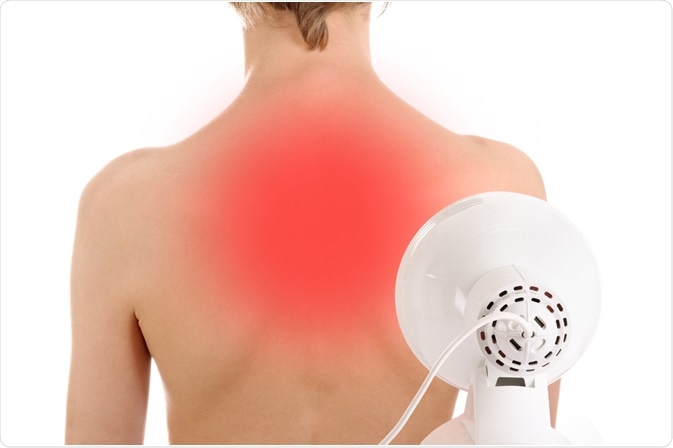
Infrared therapy is a method that uses light to treat acute or chronic pain. It is a simple and painless therapy that is being studied for use in various fields of medicine.
Marina Lohrbach | Shutterstock
What is infrared therapy?
Infrared light is one of several innovative therapies that are being trialed for the management of patients with acute or
chronic pain
. The therapy uses certain wavelengths of light that are delivered to sites of the body that have injuries.
Unlike ultraviolet light - which has damaging effects upon the tissues and cells of the body - infrared light helps cells regenerate or repair themselves. Infrared light also improves the circulation of oxygen-rich blood in the body, promoting faster healing of deep tissues and relieving pain.
One of the characteristics of infrared light is its ability to penetrate below the skin layers, providing a much greater depth which is able to effectively provide pain relief. In fact, this invasive, natural, and painless method can provide a vast range of health benefits, without damaging the skin through UV radiation
Infrared light is the heat people feel when exposed to the sun. The skin naturally radiates infrared heat every day. Infrared light has shown immense health benefits, from pain relief to reducing inflammation.
How does infrared therapy work?
Infrared light penetrates to the inner layers of the skin at about 2 to 7 centimeters deep. Hence, it reaches the muscles, nerves and even the bones. Many studies have shown that a frequency of infrared light, with wavelengths from 700 to 1,000 nanometers, is best used for healing inflammatory conditions.
The use of electricity for healing purposes began in 2,750 BC when people used electric eels to give electric shocks. Electricity and magnetism were used in people with just little success. However, in 1975, transcutaneous electrical stimulation (TENS) was developed to treat chronic pain. It was not until recently that infrared therapy was developed to improve wound healing, reduce the pain caused by arthritis, boost endorphin levels, and bioactivate neuromodulators.
Infrared therapy technology allows people to harness the benefits of the sun, without being exposed to harmful ultraviolet rays. Also, infrared therapy is safe and effective, without adverse side effects. As a matter of fact, infrared light is safe and is used even for infants in the neonatal intensive care.
Infrared light is absorbed by the photoreceptors in cells. Once absorbed, the light energy kickstarts a series of metabolic events, triggering several natural processes of the body on a cellular level.
The key to
the efficacy of
infrared light therapy may be nitric oxide, a gas that is vital to the health of the body’s arteries. Nitric oxide is a potent
cell signaling
molecule that helps relax the arteries, battles free radicals to reduce oxidative stress, prevents platelet clumping in the vessels, and regulates the blood pressure. Hence, this molecule enhances blood circulation to deliver vital nutrients and oxygen to damaged and injured tissues in the body.
The increase in the blood flow to the different parts of the body makes it possible for oxygen and nutrients to reach the cells, enabling them to function properly and effectively. Hence, this therapy stimulates the regeneration and repair of injured tissues, reducing pain and inflammation.
Infrared light therapy is applied in the treatment of various health conditions, including back pain, arthritis, bursitis, blunt trauma, muscle strain, carpal tunnel syndrome, neck pain, back pain, diabetic neuropathy, rheumatoid arthritis, temporomandibular joint pain (TMJ), tendonitis, wounds, sciatica, and surgical incisions.
Conclusions and perspectives on infrared therapy
Infrared therapy is a safe and effective way to reduce pain and treat a wide array of conditions. It seems to be a safe, effective, and drug-free way for long-lasting pain relief. It also helps to heal injured body parts.
With the treatment of injuries come multiple benefits such as pain relief, reduction of inflammation, and the restoration of the function of the affected body part. Other conditions that can be treated by infrared therapy include joint pain, joint inflammation, muscle pain, spine injuries, nerve pain, and sports injuries.
Angela is a nurse by profession and a writer by heart. She graduated with honors (Cum Laude) for her Bachelor of Nursing degree at the University of Baguio, Philippines. She is currently completing her Master's Degree where she specialized in Maternal and Child Nursing and worked as a clinical instructor and educator in the School of Nursing at the University of Baguio.
Please use one of the following formats to cite this article in your essay, paper or report:
APA
Laguipo, Angela. (2019, January 08). How Does Infrared Therapy Work?. News-Medical. Retrieved on July 08, 2025 from https://www.news-medical.net/health/How-Does-Infrared-Therapy-Work.aspx.
MLA
Laguipo, Angela. "How Does Infrared Therapy Work?".
News-Medical
. 08 July 2025. <https://www.news-medical.net/health/How-Does-Infrared-Therapy-Work.aspx>.
Chicago
Laguipo, Angela. "How Does Infrared Therapy Work?". News-Medical. https://www.news-medical.net/health/How-Does-Infrared-Therapy-Work.aspx. (accessed July 08, 2025).
Harvard
Laguipo, Angela. 2019.
How Does Infrared Therapy Work?
. News-Medical, viewed 08 July 2025, https://www.news-medical.net/health/How-Does-Infrared-Therapy-Work.aspx.
News-Medical.Net provides this medical information service in accordance
with these
terms and conditions
.
Please note that medical information found
on this website is designed to support, not to replace the relationship
between patient and physician/doctor and the medical advice they may provide.
To start a conversation, please log into your AZoProfile account first, or create a new account.
Registered members can chat with Azthena, request quotations, download pdf's, brochures and subscribe to our related
newsletter content
.
Content provided on any AZoNetwork sites are subject to the site
Terms & Conditions
and
Privacy Policy
.
Large Language Models can make mistakes. Consider checking important information.
Please check the box above to proceed.
While we only use edited and approved content for Azthena
answers, it may on occasions provide incorrect responses.
Please confirm any data provided with the related suppliers or
authors. We do not provide medical advice, if you search for
medical information you must always consult a medical
professional before acting on any information provided.
Your questions, but not your email details will be shared with
OpenAI and retained for 30 days in accordance with their
privacy principles.
Please do not ask questions that use sensitive or confidential
information.