An F-22 Raptor, assigned to the 94th Fighter Squadron, takes flight to Powidz Air Base, Poland, Apr. 6, 2023. U.S. Air Force photo by Senior Airman Chloe Shanes.
Expand Photo
Air Force
F-22 Raptors
flew to Ämari Air Base, Estonia, earlier this month to demonstrate NATO’s integrated air defenses along the alliance’s eastern flank, according to a May 14
press release
.
The 12 fifth-generation stealth fighters are assigned to Joint Base Langley-Eustis’ 94th Expeditionary Fighter Squadron and deployed to Powidz Air Base in Poland starting in early April before flying to Ämari on May 8, the release stated. Though it was not clear how much time the fighters spent in Estonia, the release said the deployment was meant “to deter aggression in the Baltic Sea region.”
Though much attention is still focused on Russia’s ongoing war in Ukraine a few hundred miles southeast of the Baltic states, national security experts warn the region is a significant strategic and economic area where Russia may attempt to undermine NATO.
“Gray zone operations are underway, and the United States, NATO, and their partners need to be ready to act in unity against an increasingly hostile Russia that is now trying to distract attention from its military shortcomings in Ukraine,” wrote security experts Courtney Herdt and Matthew Zublic in November for a Center for Strategic & International Studies
report
on Russian operations in the Baltics.
“In this effort, Russia’s playbook will test the limits and try to exploit the seams of the alliance,” they continued. “An exacting response is needed to deny Russia control and ensure full conflict is avoided.”
Indeed, late last month, German and British Eurofighters intercepted two Russian Sukhoi Su-27 fighters and one Ilyushin Il-20 while the Russian aircraft were flying without transponder signals in international airspace over the Baltic Sea,
according
to Reuters. The NATO fighters were part of the alliance’s Baltic air policing mission, one of several efforts to defend the region against Russian air attack.
“The Baltic nations—Estonia, Latvia and Lithuania—are situated on a critical air, land, and sea corridor, which requires a coordinated approach between allies to maintain and sustain international freedom of maneuver throughout the region,” the Air Force release stated.
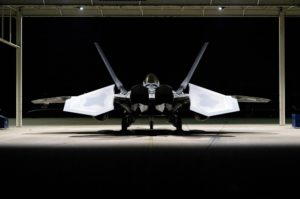
An
F-22 Raptor
, assigned to the 94th Fighter Squadron, awaits inspections before take-off to Powidz Air Base, Poland, Apr. 6, 2023. U.S. Air Force photo by Senior Airman Chloe Shanes.

A crew chief assigned to the 94th Fighter Squadron salutes the pilot of a F-22 Raptor as it taxis to the flightline at Joint Base Langley-Eustis, Virginia, Apr. 6, 2023. U.S. Air Force photo by Senior Airman Chloe Shanes.

Airmen assigned to the 1st Fighter Wing board a C-17 Globemaster III before departing to Powidz Air Base, Poland, Mar. 28, 2023. U.S. Air Force photo by Senior Airman Chloe Shanes.
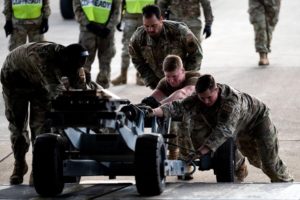
Airmen assigned to the 633d Logistics Readiness Squadron push an equipment transport cart onto a C-17 Globemaster III at Joint Base Langley-Eustis, Virginia, Mar. 28, 2023. The cargo will be utilized at Powidz Air Base, Poland, as U.S. forces begin incorporating Agile Combat Employment concepts. U.S. Air Force photo by Senior Airman Chloe Shanes.
Another effort is a Spanish National Advanced Surface-to-Air Missile System (NASAMS) deployed to Latvia and coordinating with the Latvian Control and Reporting Center. The arrival of the Raptors makes the region’s air defenses even more secure.
The fifth-generation F-22, with its low observability, advanced sensors, and maneuverability, would make an attack on the Baltics a much more daunting prospect for Russian war planners. The Air Force release said the Raptor movement to Estonia was “an
Agile Combat Employment
deployment,” referring to the Air Force’s plan to complicate an enemy’s targeting process by moving air assets quickly between small air bases throughout an area of operations.
By “rapidly fielding” the F-22s in Estonia, the service emphasized “the operational readiness of the coalition forces throughout the European theater and their ability to respond to defend NATO territory,” the release said.
Subscribe to the Daily Report
Get your daily fix of Air & Space Force news delivered right to your inbox every day. There's no more reliable source for news about your Air & Space Forces.
Subscribe Today
Air Force Investigates After B-52 ‘Crabbing’ at Airshow Appears to Knock Out Runway Lights
July 19, 2023
U.S. and allied air forces are wrapping up one of their largest mobility exercises in history: Mobility Guardian 23. The drill is designed to take on the challenges of operating in the vast Pacific region, now the primary focus of America’s military strategy. “The joint force cannot fight if they're…
Six different countries participated in a “elephant walk” at Andersen Air Force Base in Guam on July 19, showcasing the vast array of aircraft currently in the Indo-Pacific. The air forces of the U.S., United Kingdom, Canada, Australia, Japan, and France all contributed to the 23-plane formation, which included fighter, bomber,…
Thirty years ago, the National Guard Bureau established its State Partnership Program (SPP) by pairing 13 former Soviet bloc countries with state National Guards to bolster training and cooperation. Today, more than 100 countries around the globe are in the program, with 88 active partnerships. All 54 states, territories, and…
The heads of the U.S., British, and Australian air forces all signed a “joint vision statement” declaring their intent to work together in developing the E-7 Wedgetail for airborne early warning and control, the U.S. Air Force announced July 17. USAF did not immediately provide Air & Space Forces Magazine with…