
|
|


琉球语的现状是怎样的?
关注者
231
被浏览
173,233
9 个回答

“Niinaga, Ishihara and Nishioka (2014) point out that the local languages in Amami, Kunigami and Okinawa are usually only spoken by the older generations of grandparent and great-grandparent age. Aso, Shimoji and Heinrich (2014) report the same for Miyako, Yaeyama and Yonaguni, in the southern part of the Ryukyuan Archipelago.”

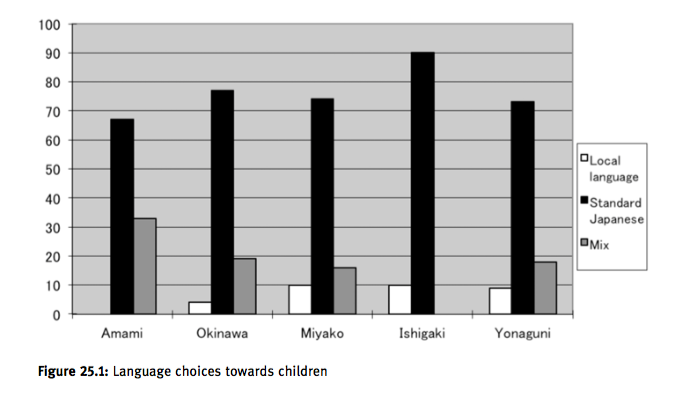

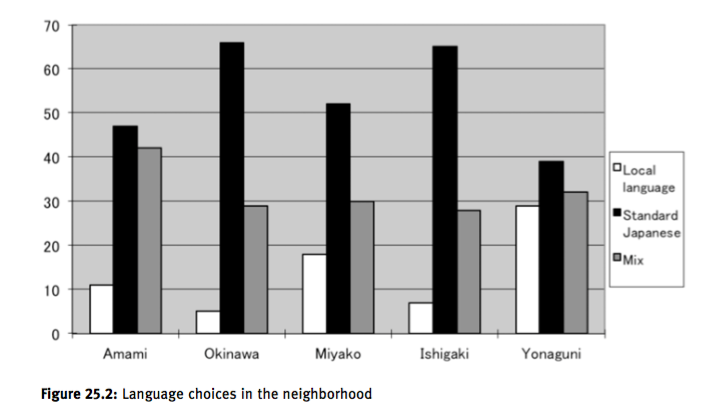
“The Ryukyuan languages are endangered today because Ryukyuans strove to escape US occupation, and reversion to Japan was the sole feasible means to achieve this at the time (see Taira 1997: 160). Given the way that Japan was invented as a monolingual and linguistically homogenous nation (Heinrich 2012a), Ryukyuans across all local communities underlined their desire to be recognized as Japanese by raising their children in Japanese-speaking households from the 1950s onwards. Given the fact that language transmission has neither been restored in the family domain, and it is not being transmitted in school either, the prospects for the Ryukyuan languages are grim. At present, the third generation is now being raised without active proficiency in the local languages. Given this outset, Anderson (2009: 284) predicts that Uchinaaguchi spoken by full speakers will become extinct by 2030, and the situation in the Yaeyama Archipelago and in Yonaguni is yet more critical (Moseley 2009).”
“Niinaga, Yūto, Masahide Ishihara and Satoshi Nishioka. 2014. Kita-Ryūkyūgo (Amami, Kunigami, Okinawa) no sonzokusei to kikido [Language vitality and endangerment in Northern Ryukyuan (Amami, Kunigami, Okinawa)]. In: Michinori Shimoji and Patrick Heinrich (eds), Ryūkyū shogo no hoji o mezashite [In Pursue of Ryukyuan Language Maintenance], 95–142. Tokyo: CoCo Shuppan.”
“Aso, Reiko, Michinori Shimoji and Patrick Heinrich. 2014. Sakishima no gengo kiki to sonzokusei [Language endangerment and vitality in Sakishima]. In: Michinori Shimoji and Patrick Heinrich (eds), Ryūkyū shogo no hoji o mezashite [In Pursue of Ryukyuan Language Maintenance], 144–158. Tokyo: CoCo Shuppan.”
“Taira, Koji. 1997. Troubled national identity. The Ryukyuans / Okinawans. In: Michael Weiner (ed.), Japan’s Minorities. The Illusion of Homogeneity, 140–177. London: Routledge.”
“Heinrich, Patrick. 2012a. The Making of Monolingual Japan. Language Ideology and Japanese Modernity. Bristol: Multilingual Matters.”
“Anderson, Mark. 2009. Emergent Language Shift in Okinawa. Ph.D dissertation, Sydney University.”
“Moseley, Christopher (ed.). 2009. Atlas of the World’s Languages in Danger. Paris: UNESCO. Available online at: http://www. unesco.org/culture/lang uages-atlas/ (accessed on 20 August 2012).”
摘录来自Patrick Heinrich, (25) Language shift in Heinrich, Patrick;Miyara, Shinsho;Shimoji, Michinori. “Handbook of the Ryukyuan Languages”。
琉球语方言的濒危程度:(UNESCO)
definitely endangered 危険
奄美方言
沖縄方言
宮古方言
severely endangered 重大な危険
八重山方言
与那国方言
------------------------------
好想去与那国和宫古田调啊啊啊
Sim-CH

葉典編輯、官方群裙主;IRG/Unihan/SAH常駐人員。
謝邀。
現狀真的不行了。
去年暑假去了數十個比較偏僻的小島上做方言調查,反正就是去問年輕人的時候他們基本統一回復,找60歲以上的老人吧。
更有些看上去應該已經過了60的人還會給我講讓我去找七八十的那些,我*……
給我印象最好的是沖縄北部的伊江島上還有看上去四十左右的中年人會一點方言。但真的很稀缺了(可能別的島上也有,我剛好在伊江島上遇到而已)。
另外就是那邊的役場(可以理解成政府吧)的工作人員真的超級好,跟他們說明情況之後他們會幫忙主動聯繫,不過聯繫的基本也都是有點文化的老年人hhh
說到文化水平,有點水平的人基本都去東京大阪這種大地方謀生了,所以島上基本以老年人和小孩兒居多,農民挺多的,特別是在宮古伊良部島那邊兒,一下公交車放眼望去全是田,不開地圖真的得迷路那種。能碰到一些有些文化水平的老年人其實也挺不容易啦。
關於方言保護,我所知道的是德之島上已經有相關的協會了,就不知道有多少人會去真正響應。要是是像上海這樣學幾個單詞學幾句常用語就冠名為「上海話興趣班」的這種力度那還真是不敢恭維(不過我也沒真正去瞭解過。那天在德之島伊仙待的時間不長,公交車班次限制了我的出行)
按國際上對語言瀕危程度的定義琉球語的各方言基本都算是瀕危或極度瀕危了。我也做不了甚麼,但願琉球語能苟住,多活一年是一年吧。